a multicultural Research Library
Making multicultural Australia
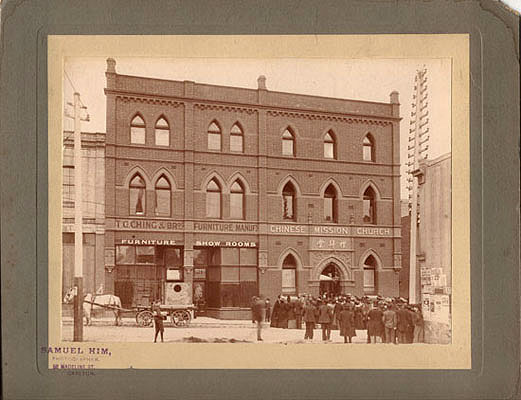
Frontages of successful merchant houses next to Christian churches (Slide 5)
Andrew Jakubowicz.
By the 1890s, the red-brick frontages of successful merchant houses sat side by side with Christian churches, society clubhouses and other 'respectable' premises that gave Little Bourke Street its distinctive late-Victorian solidity and human scale.
Created:
unknown
Date Added:
03 February 2009
Source:
source not available
Format:
jpg (JPEG Image);
File size:
48 KB
Dimensions:
521 x 400
Transcript
By the 1890s, the red-brick frontages of successful merchant houses sat side by side with Christian churches, society clubhouses and other ‘respectable’ premises that gave Little Bourke Street its distinctive late-Victorian solidity and human scale. The fabric of Melbourne’s ‘Chinese Quarter’ was added to and improved from its beginnings in the 1850s to its peak and then decline by the 1920s.
Museum of Chinese Australian History
Item: 2006.01.03; c. 1920s
Photographer Samuel Him, 55 Madeline St, Carlton
View other images on Cultural Studies
 Mabel Chinn with her husband Chinn Tong Coon and children Eunice, Valda and Max
- Chen Wang in her class photo in 1932
- Victoria Religious Leaders (Slide 6)
- "Brisbane Buddhas", Museum of Brisbane exhibition, 2005 (Slide 3)
- Somali gardens: starting again - Asli Arab (4)
- Large prints attached to building (Slide 8)
View other Artworks
- Disappointment (detail)
- A meeting of new immigrants in the 1970s - Whole Image
- Brunswick Baths Mural (slide 08)
- Drawing by child in detention - 1
- Women
- Disappointment
Visit the multicultural Library for other documents, video, audio and images.